
Why your website isn’t bringing in enquiries: a guide for York businesses
Your business website explains what you do, lists your services, and shares details on how to get in touch with any questions. But the enquiries aren’t quite at the volume you want or need.
Maybe you get the occasional message, but it’s usually about work you don’t want, or a spam email that gets your hopes up for a second before you realise it’s nothing. Your traffic figures look fine, but you can’t work out why that isn’t turning into leads.
Before you hike up the ad spend, start again with a new website, or worse, give up completely, it’s important to establish what the problem really is. Are the right people landing on your site? Is it clear that you can help them? Does the path to a purchase, booking, or enquiry make sense?
Those questions lead down different avenues to different tasks. This guide explains how to investigate them.
What does a good enquiry look like for your business?
Before deciding whether your website brings in enough enquiries, be clear about the kind of work you want those enquiries to lead to.
A good enquiry comes from someone whose needs match what you offer. They might still be comparing prices, asking questions or working out what they need. What makes the enquiry valuable is that there’s a realistic prospect of it becoming work you want to take on.
Imagine you’re a piano teacher in Fulford, York. You teach adult beginners and have space for two more regular evening students. Someone asking about weekly lessons after work is a promising enquiry: their needs could fit both your teaching and the gaps in your diary.
A parent asking about Saturday morning lessons for a young child needs something different. It’s a perfectly reasonable request, but if you only teach adults on weekdays, it won’t lead to a booking.
That distinction helps you decide what needs fixing. If you regularly receive requests for things you don’t or can’t offer, check whether your website clearly shows who your ideal customer is.
In the case of our piano teacher, general mentions of “Piano lessons in York” leave that question open. Information about suitable students, lesson times and the teaching approach would help people work out whether the fit is right.
Apply the same thinking to your own business. So here’s an exercise. Write down:
The work you want more of: particular services, projects, bookings or repeat business.
Who that work suits: the people whose needs you’re equipped to meet.
Any practical limits: your service area, availability, minimum project size or other requirements that affect whether you can help.
Then compare that description with your recent genuine enquiries, including phone calls, emails and messages.
If most of your enquiries are a good fit but there just aren’t enough of them, the next step is to investigate how people find you and what might stop them getting in touch.
If you’re repeatedly explaining that you don’t cover someone’s area, offer the service they’ve requested or work within their budget, check whether your website makes those details clear. Before you go chasing more visitors, you want to make sure it doesn’t simply lead to more of the same unnecessary conversations.
For our piano teacher, a clearer website might produce fewer messages overall but more bookings for the available evening lessons. That would be a better result - and something a visitor count or enquiry total alone wouldn’t make obvious.
First, check that enquiries can reach you
This is the unglamorous part. And you should do it before rewriting anything.
Open your website, ideally using an incognito tab, signed out of the accounts you use to manage it. Find your main service, follow the contact link and submit a hypothetical enquiry. Check what happens on the page and whether the message reaches the inbox you actually monitor.
A confirmation screen and a delivered email are two separate things. A form might store submissions in the website dashboard while its notifications go to an old address. A spam filter might catch a perfectly ordinary message. A contact button might open an email address with a spelling mistake. Yes, I’ve seen all of these things!
Double-check telephone numbers and booking links. If you offer several contact methods, work through each one. Make sure an old social profile is not directing customers to a page you removed last year.
Then consider what happens after contact. Who replies? Where does the message appear? Do you explain what happens after someone gets in touch? Ideally, a person contacting you or requesting a quote needs to know whether they have successfully entered a conversation.
This could be an easy win. Fixing a failed enquiry route is a specific, observable improvement. You don’t need a month of analytics to establish that a working form is preferable to a broken one.
Find out whether suitable people are discovering the site
If contact works, it’s time to investigate discovery.
A good place to start is with a Google Search Console’s performance report.
It shows Google search impressions, clicks, queries and landing pages, so it can help you see what people searched for before reaching your website and which pages attracted those clicks.
Look for patterns rather than inspecting one impressive average. Does the traffic relate to the services you want to sell? Are visitors landing on a relevant service page, an old article or a page that no longer describes the business?
Searches for your business name tell a different story from searches for a service. Someone looking you up after a recommendation already knows who you are. Someone searching for an evening piano teacher in York is still choosing. Both can be valuable, but they represent different opportunities. Are people finding you through word of mouth or organically?
If applicable, review your Google Business Profile too. Check the category, contact information, service area, opening hours and linked website. Google describes local ranking in terms of relevance, distance and prominence; complete information helps it understand the business, but it can’t make your premises closer to every searcher. Check out its local ranking guidance for more on that.
Separate useful visits from impressive-looking totals
Imagine a business whose most popular article answers a question for readers around the world. Maybe an electrician in York has written an incredible guide on rewiring a house. That article may be useful and successful on its own terms, but its readers may still have very little reason to buy a local service. I once worked with a client that had a single blog getting thousands of views every month from readers around the world.
This is why the amount of traffic you get is an incomplete diagnosis. To win new business, you need relevant traffic. You need people who need you to find you.
It’s useful to group your website’s pages by the job they do. A service page should help a prospective customer assess your offer. A project story should demonstrate relevant experience and expertise. An advice article might introduce the business to someone who has not heard of it before and establish your credibility.
Start with your most-visited pages and the searches bringing people to them. Are those searches connected to the services you sell? Do they suggest a need you can meet? For our electrician, searches about rewiring costs in York are more closely connected to potential work than general searches for DIY wiring instructions.
Where an advice article attracts potential customers, give those readers a clear route to the relevant service. The rewiring guide could link to a page explaining which areas the electrician covers, what the service involves and how to request a quote. That helps someone move from researching a problem to considering the business that could solve it.
If most visitors are looking for information with little connection to the work you want, the priority is to attract a more relevant audience. Publishing another broadly popular article might increase traffic without bringing you any closer to that goal.
This also changes how you should judge the website’s performance. Look at whether people reach the pages that explain the services they might buy. A popular advice article can have value, but its entire audience shouldn’t be treated as potential customers who failed to enquire.
Use evidence that answers a specific doubt
“Friendly and professional” is pleasant feedback, but it leaves quite a lot unexplained.
Someone returning to piano after thirty years may worry about feeling embarrassed. A genuine review from an adult learner describing a patient, encouraging approach speaks directly to that concern. A photo of the teaching space can help them picture the session. A clear account of your experience explains why they should trust your judgement.
The same principle applies to project-based businesses. Show the work, explain the brief and describe your contribution. If you publish a result, make sure you can support it. A useful case study needs enough detail to help someone understand what you delivered.
Place relevant evidence alongside the decision it supports. A visitor reading about a particular service should not have to find a separate testimonials page to discover whether you have done that kind of work.
Specific evidence also helps you avoid making the page louder when it needs to become clearer. Replacing “excellent” with “exceptional” adds very little. Explaining the problem you solved gives the reader something new.
Make the next step match the decision
Your contact form should ask for enough information to make the next exchange useful.
For our piano teacher, a learner’s experience, preferred availability and contact details could be a sensible starting point. Making them select an examination grade before they can submit would undermine the promise that complete beginners are welcome.
For another business, an extra question may be necessary. The right form depends on the work. The aim is to remove questions that serve no purpose while keeping the information needed to respond properly.
The W3C’s accessible forms guidance suggests you have clear labels, useful instructions and feedback about errors or successful completion. Test those details on a phone. Can someone understand a field without guessing? If they make a mistake, can they find and correct it?
Explain what the action means, too. “Enquire about lessons” prepares someone for a conversation about availability. “Book now” suggests they can secure a lesson. Use the wording that accurately describes what happens.
Finally, add a realistic explanation of the response process. If you usually answer between appointments, say what a customer can expect without promising an instant reply. A small amount of reassurance can make the interaction feel more considered.
Be your customer
Your next step is to follow your customer journey all the way through.
The piano teacher wants more adult beginners but has a homepage dominated by examination results. The contact form works, although its required “current grade” field makes starting from scratch awkward. Search data, in this hypothetical scenario, suggests that some relevant visitors already reach the lessons page.
Those observations support a clear first project: explain the adult beginner offer, answer the practical questions, add relevant evidence and make the enquiry form suitable for that audience.
They do not, by themselves, establish a need for a different website platform. They also do not prove that the changes will produce a particular number of students.
Now change one fact. Suppose the lessons page receives almost no relevant visits. The improved offer is still worthwhile, but discovery needs attention alongside it. Or suppose the teacher has no evening availability. The copy should say that, rather than attract enquiries the business cannot fulfil.
That is the value of diagnosis. The proposed fixes follow from the situation, including the inconvenient parts. You get a reason for each change instead of a familiar list of marketing tasks.
Fix the most critical things first using evidence and consequence
You probably have enough ideas already. The difficult part is deciding which one deserves your time or budget.
Here’s a useful starting point:
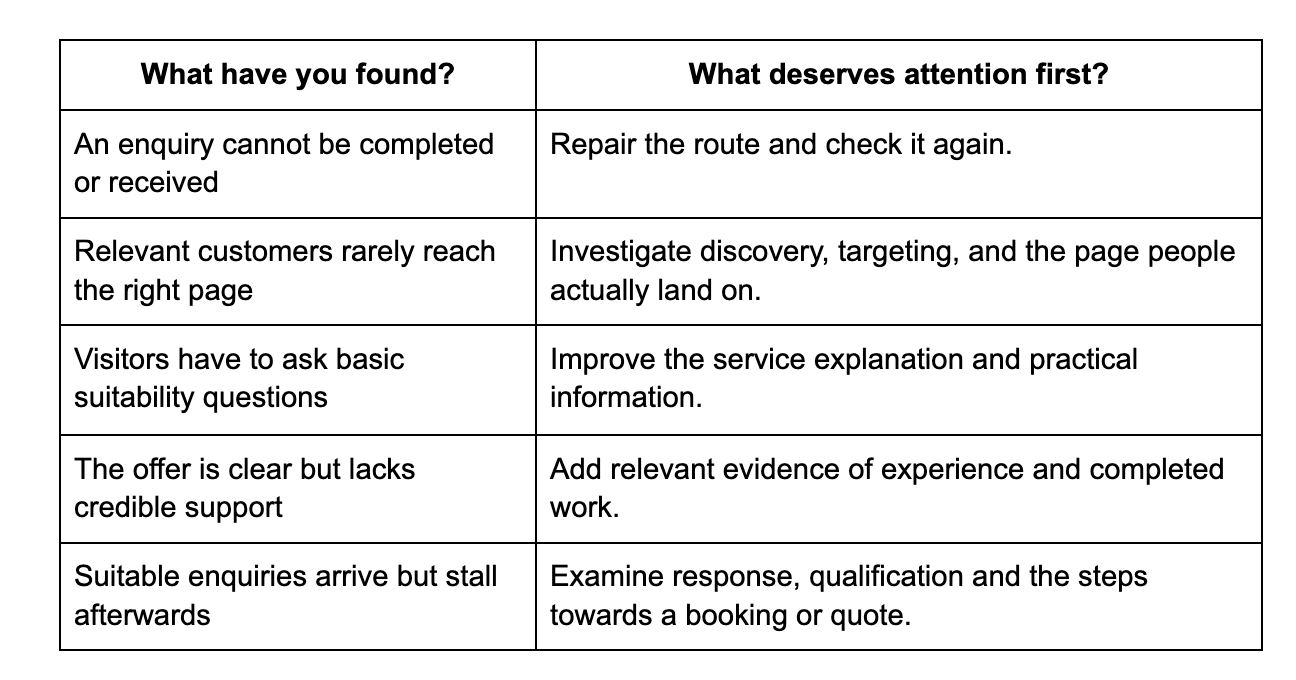
Your business might have several problems at once. Start with a change you can justify, define what a good result would look like and keep a record of what you alter.
A broken booking link has a direct consequence and a clear repair. A suspicion that a different homepage colour will improve sales needs a stronger argument. Give the obvious problem priority.
Check whether your changes lead to better enquiries
One common theme I’ve seen with clients is the desire to make drastic changes to their websites because things simply aren’t working. But drastic doesn’t always mean systematic. Before changing a page, take time to consider the problem you want to solve and how your changes are going to solve it.
Then, once you have implemented a change, keep tabs on whether it’s doing what you hoped.
Get a clearer picture of what your website needs
A decent website review should connect observations to actions. I help York businesses review their websites, improve their content and make the route to an enquiry, booking or purchase work properly.
If your website isn’t doing enough, I can help. My website and local SEO service can take you through all the steps to get noticed locally, improve your relevant traffic, and generate new business.